Collectors who dig into postcard boxes are finding something surprising: small, colorful pieces of commercial art that slipped out of their original world and into family albums. Fresno fruit crate labels keep turning up taped to the backs of postcards, tucked between snapshots, or folded inside letters. They aren’t meant to be rare treasures, but they’ve become exactly that for people who care about design, agriculture, and local memory.
## Fresno Fruit Crate Labels Surface In Postcard Archives
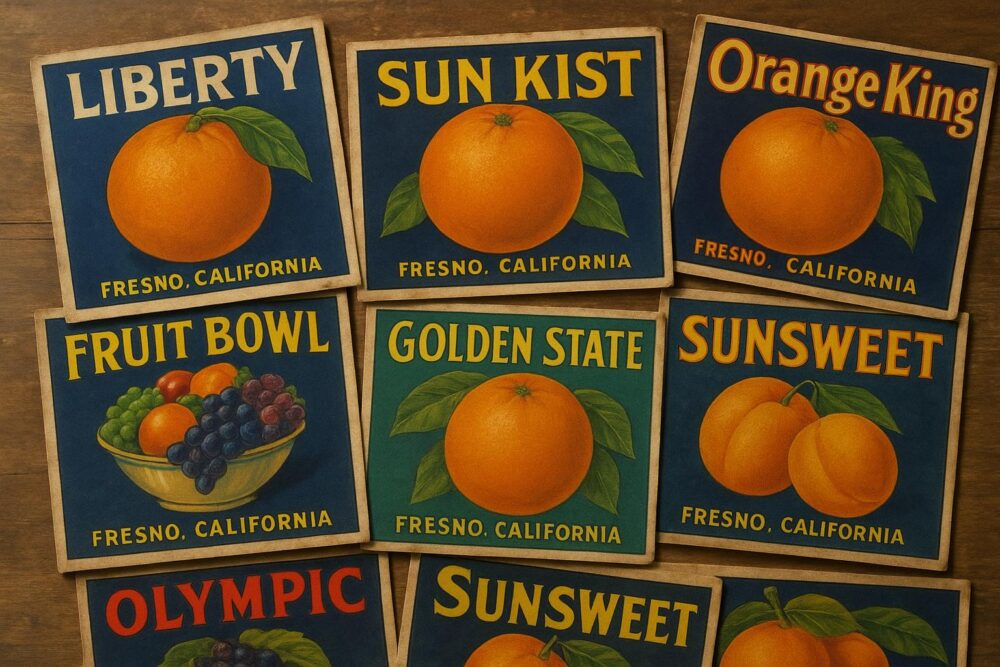
The labels look like miniature posters. Bright lithography, bold type, hand-drawn fruit and sometimes a portrait or mascot. For decades, fruit companies in the San Joaquin Valley printed labels that could be glued to wooden crates and boxes. A crate might have carried peaches for three weeks, but the label was made to last through heat, humidity and handling. That durability is one reason so many survived and later showed up in postcard collections.
Why postcards? Simple: people liked to keep pretty things. Labels offered color and novelty. A housekeeper might glue a label into an album because it caught the eye, or a packer could have peeled one off and kept it for later. When collections get donated to libraries and historical societies, those albums end up in the same cartons as postcards. Archivists opening the boxes find the labels mixed in with holiday greetings and travel notes. Some labels were even used on envelopes as makeshift stamps, which explains the stray postmarks.
### Why Postcards Held Labels
Postcards were often ephemeral but durable objects. They survived because someone kept them, not because they were meant to. That’s the same story for many fruit crate labels. The two things ended up together in shoeboxes and albumes meant for safekeeping. Labels offer a little more than nostalgia; they carry corporate identity, local pride, and often a date or packer’s name that helps pin down a particular season.
Archivists who first noticed the pattern describe mixed reactions. A librarian in Fresno told me she opened a donation and found a dozen labels stuck to the inside cover of a postcard album. The handwriting suggested they were saved by a farm family. In another box, a string of labels had been pinned together like a miniature bunting. These objects sit at the intersection of domestic life and commercial farming.
### The Visual Language Of The Labels
Look closely and you see a vocabulary: oversized fruit, animated children, pastoral orchards, sunbursts and banners. Printers leaned on a few tactics to make a crate stand out at market: saturated color, dramatic typography, and an emblem or mascot that could be recognized at a distance. Some labels emphasize origin — “Fresno” prominently displayed and surrounded by fruit — while others sell an idea, like “Valley Sunshine” or “Royal Selection.” The labels were not just identifiers; they were a promise of quality.
Designers borrowed from lithography traditions, adapting techniques from poster art and packaging. Bold serif typefaces were common, sometimes hand-lettered. Chromolithography allowed for gradients and more nuanced shading than earlier methods, which made fruit look almost three-dimensional. That mattered: a crate that looked fresh encouraged buyers to pick it up in a busy depot.
#### Common Motifs And Brands
You’ll see recurring themes across labels: bunches of grapes perfectly lit, peaches with velvety fuzz suggested by soft shading, and citrus rings cut to show texture. Personal or place names were popular too. A packer might brand a line as “Fresno Pride” or a grower could use a family surname. Some labels include country scenes or industrial motifs, suggesting scale and reliability. Others go whimsical, with animals or cartoon characters lending personality.
## What Archivists Did To Catalog Them
When postcard collections arrived with labels attached, archivists faced a choice. Remove the label and conserve it as a separate artifact, or document it in situ and preserve the album intact. Both approaches are valid depending on provenance and condition. Often they photograph the page first, then make a decision. Conservation work can be delicate: the adhesive used a century ago may have browned or fused paper layers together.
Cataloging is another challenge. Which subject headings capture the object? “Fruit crate labels” is one, but so is “Fresno agricultural ephemera” or “packaging design.” Metadata matters because it shapes how researchers — historians, designers, collectors — will find the items later. That’s also why some archivists attach more detailed notes: where the album came from, whether the labels have visible dates, or if the packer’s name connects to a known business.
Archivists sometimes find the tags in surprising contexts. One county archive had a travel diary from the 1920s with a sheet of labels taped to the back page; the diary’s owner had been traveling as a fruit buyer. In a university special collections, crates of postcards donated by a local family turned out to be a goldmine for agricultural historians. It’s these cross-connections that make the discovery valuable beyond mere decoration.
#### Condition And Conservation
These labels were meant to stick. Removing them can cause tears or surface loss. Conservators test adhesives and paper fibers before proceeding. Often they humidify the paper gently to loosen glue, then lift with microtools. If removal risks real damage, they digitize and don’t separate. Stabilizing fragments sometimes requires backing them with Japanese paper and a reversible adhesive. The goal is to keep as much original material as possible while making the item accessible for study.
## Why Collectors Care About Fresno Fruit Crate Labels
Collectors don’t collect just because something is pretty; they collect because the piece tells a story. Fresno fruit crate labels capture a particular place and industry. They’re visual shorthand for an economy: orchard maps, crop cycles and branding battles all printed on a piece of paper no larger than a postcard. For local collectors, the labels are family history. For designers, they’re a snapshot of commercial aesthetics. For museums, they document the intersection of culture and commerce.
The labels also have an emotional pull. People who grew up in the Valley remember crate stacks at train depots, or the smell of fruit in packing sheds. A label with a familiar orchard name can trigger memories of relatives who picked or packed fruit. That makes some of these pieces far more than decorative: they’re repositories of lived experience.
### Market And Value
Value depends on the usual suspects: rarity, condition, artwork and provenance. A rare label with a well-documented packer’s name and a vivid illustration will command higher prices. Labels that are unique — a special promotion, a seasonal variant, or a misprint — attract collectors quickly. The marketplace is lively enough that auctions and Etsy listings can show sudden spikes in demand.
Fresno-focused collectors pay attention to the same details. A label that reads “Packers of Fresno Gold” might fetch more among local collectors. Conversely, a mass-produced label seen in dozens of archives is less valuable unless it has an unusual graphic. The presence of a postmark on the same page as the label can also add provenance, tying the object to a time and place.
You’ll also hear the phrase fresno crates labels used among dealers, sometimes interchangeably with the broader term. That shorthand owes to archives and dealers who categorize by region and type. For a newcomer, understanding these distinctions helps when evaluating a piece.
### Display And Use
These labels are small and versatile. They’re often framed in tight groupings, used in collage work, or mounted in shadow boxes with packing twine. Interior designers have used them in kitchen installations and cafe displays. Museums exhibit them alongside crates and tools to recreate packing sheds. There’s a tactile pleasure to seeing a bright label in an old wooden crate.
Artists and crafters appreciate their scale. A single label can anchor a mixed-media piece or be repeated in a grid for a wallpaper-like effect. Labels printed on archival paper can be scanned and reproduced for educational displays without risking the originals. That practice keeps the physical items safe while making their imagery widely accessible.
## How To Start Looking Through Postcard Archives For Labels
If you want to find these labels, start local. County historical societies, university special collections and small-town libraries often have postcard and photograph donations waiting to be cataloged. Donors sometimes lump everything together: a shoebox of letters, a stack of postcards, and a handful of labels. Ask to see donations before they are rehoused. Bring gloves and a loupe if you have them. Most institutions welcome informed interest.
Digital outreach helps too. Many archives have online catalogs with keyword searches. Try variations: “fruit crate labels,” “Fresno fruit crate labels,” “citrus labels Fresno,” and even “fresno crates labels” to catch different cataloging styles. If a catalog entry is sparse, make a polite request to a curator for more information or a high-resolution image. Researchers have scored finds by simply asking staff to take a closer look at uncataloged boxes.
### What To Ask Archivists
When you find mention of a label, the right questions clarify value and access. Ask about provenance: who donated the album and what context was given? Ask whether the label is attached and, if so, whether removal was considered. Inquire about digitization: has the page been photographed, and can you see the image online or request a copy? Finally, ask about handling rules: some collections restrict photography or require supervised access.
#### Rights And Reproductions
Reproduction rights can be messy. Many labels from the early 20th century are in the public domain, but not always. If you want to publish an image, verify the archive’s policy and any donor restrictions. Some repositories charge a fee for high-resolution files or reproduction rights. If a label belongs to a living company or a trademark is still active, a quick check with legal counsel or the archive’s rights officer makes sense. Still, for most personal study and non-commercial use, institutions are accommodating.
## The Cultural Value Beyond Collecting
Beyond market prices and display trends, these labels tell a larger story about place, labor and identity. Fresno’s role as a fruit-producing hub is embedded in them. The imagery speaks to migration patterns, to labor forces who packed fruit at dawn, to the ways small growers tried to compete with larger concerns through savvy design. They are evidence of a supply chain that relied on countless hands and simple pieces of paper to communicate quality.
Occasionally, a label gives a lead a historian can follow: a packer’s name, a business address, a reference to a packing house. Those breadcrumbs can turn into oral histories, property records and deeper narratives about the region. In that sense, the labels are more than eye candy. They’re primary sources that link the domestic and commercial archives, the family album and the packing shed.
Finds keep appearing. You never know where the next set of Fresno fruit crate labels will turn up — in a recipe box, slipped into a Bible, taped behind a postcard, or filed among a farmer’s receipts. The work is slow and precise, but when a well-preserved label emerges it rewards patient looking with a small, vivid piece of the past.