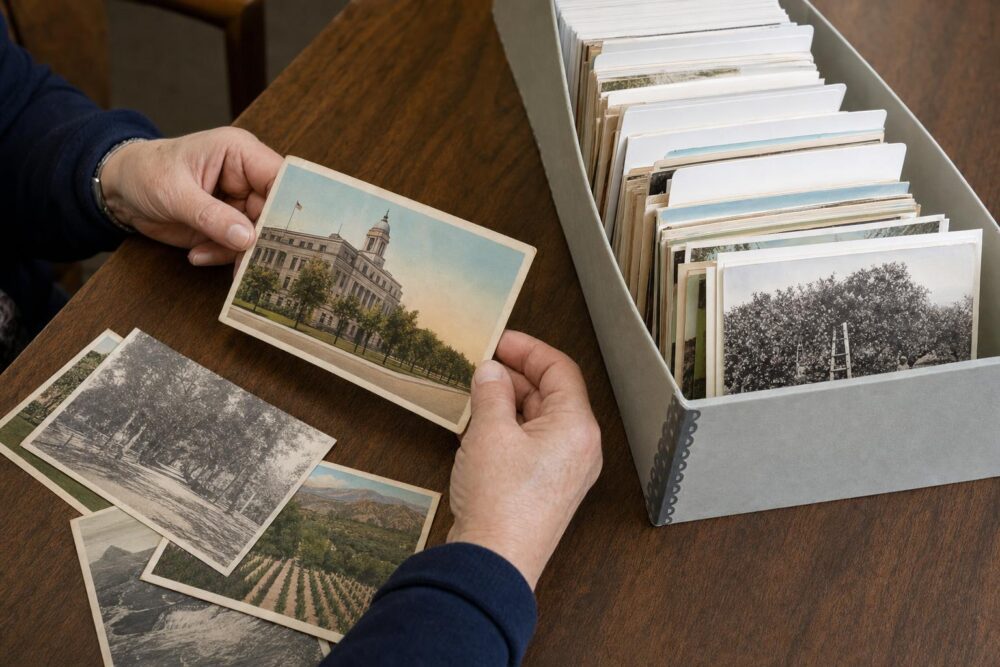
The stacks at the county archive don’t smell like a museum. They smell like paper left out in sun and basements where someone kept a box “just in case.” The postcard cases are the same—cheap cardboard albums, glass-fronted frames, a few envelopes tied with string. That low-key jumble is where real history sits: small, messy, and telling.
## Inside The Fresno County Local History Archives Postcard Collection
The fresno county local history archives postcard collection is not one tidy set of identical items. It’s thousands of pieces: commercial views printed by big postcard firms, homemade real-photo postcards, and correspondence cards scrawled with shopping lists and gossip. A single card can show a Main Street storefront long gone, a water tower with a different paint job, or a parade float advertising a fair that became a ritual for families across the valley. The value isn’t just in the image. It’s in the crease where a child once folded the card, the faded postmark that pins a date, and the note on the back that mentions a worker’s commute.
These cards were made to travel. Postmarks stamped the route. Addressing conventions tell you how people wrote to each other—titles used, who got mail, which neighborhoods were considered respectable. The collection gives a ground-level view. It’s the sort of source a historian wants when they need to know not only what a building looked like, but how residents talked about it.
### What The Collection Contains
The range surprises visitors. You’ll find:
– Early 20th-century commercial postcards of downtown Fresno and neighboring towns.
– Agricultural scenes: grape harvests, packing houses, and irrigation systems.
– Ethnic neighborhoods and community halls—images that hint at social life beyond the newspapers.
– Promotional cards from local businesses and civic boosters.
– Postcards documenting fairs, parades, and civic celebrations.
A sizable chunk of the collection came from donations—estate boxes, local clubs, and families who passed cards down like photographs. Other parts arrived through active collecting by the archives, buying or exchanging copies to fill gaps. The mix gives you broad coverage but also odd little foci: one folder might have half a dozen cards of the same bakery from different years, because someone in the family always sent that image to relatives.
### Why Postcards Matter For Local History
Postcards are shorthand snapshots. They’re inexpensive, often dated by postal marks, and meant to be seen by ordinary people. That makes them excellent primary sources for neighborhood change, commercial branding, and everyday life. A city directory tells you where a dentist lived. A postcard shows you the dentist’s storefront sign, the style of awning, maybe the horse tie rings in front. The fresno county local history archives postcard collection turns details that would otherwise live only in typed sources into visual evidence.
#### Reading The Backs: Postmarks And Messages
The back of a postcard is its secret. Postmarks can narrow a range of months. Handwriting tells you about literacy trends, salutations, and social distance. A quick example: a 1915 card’s message signing “Yours truly” rather than “Love” can flag a business interaction or formal acquaintance. On the same shelf, an unsigned note that starts, “Dear Ma…” opens a window on family networks and migration patterns.
### A Few Notable Items You’re Likely To Find
The collection has several cards that recur in local exhibits and publications. One shows a Main Street intersection with streetcar tracks slicing through—useful when tracing transit routes. Another is a real-photo card of a packing house during grape season: workers posed, crates stacked, and a sense of scale that agricultural statistics can’t convey. There are also novelty cards—oversized typefaces and humorous sketches—offered by local printers trying to carve a market.
## How To Search And Use The Fresno Postcard Archives
If you type “fresno postcard archives” into a search box, the archive’s catalog is where you should end up. The online catalog is uneven: some cards are fully digitized with metadata, others are only listed by accession number. That’s normal for local repositories. Budget and staff time determine how much gets scanned.
Start with place names. Search for neighborhoods, street names, or local landmarks. If you’re researching immigrant communities, try institution names—churches, social halls, mutual aid societies—rather than ethnic labels, which weren’t always used consistently. For photographs, scans often include both sides. Look for the postmark date and the sender’s note in the thumbnail view.
### Visiting The Reading Room
Arrive with questions and patience. The reading room staff can pull boxes by accession number. If something isn’t digitized, you’ll handle originals under supervision. You can request a digital reproduction, but expect a small fee for high-resolution scans intended for publication.
Bring gloves if you prefer, but the archivists will advise on handling. Don’t expect to flip through everything unassisted. The catalog entries are your map; they’ll save you time. If you’re looking for a specific street or business, give staff any names you already have. Often their institutional knowledge points you to folders that the computer doesn’t highlight.
### Searching Offline Records
Not everything is indexed. Sometimes the best approach is to request boxes by decade or region and look through. That’s slower, but serendipity is part of the joy. You might find a set of minor-town views documenting a now-vanished rail spur, or a trove of fair postcards donated by a local family.
## Preservation And Digitization Efforts
Preserving postcards requires a practical approach. They’re printed on acidic stock. They curl, they tear, they bleach under light. The archives prioritizes flattening, rehousing in acid-free sleeves, and scanning items with significant research value. The collection has benefited from grant-funded projects that digitized high-demand sections. Still, many items remain in physical form.
Digitization solves access—but it isn’t a panacea. Scans remove the tactile clues: paper thickness, grain, and the faint impressions of writing. That’s why researchers still request originals. When possible, check both the digital image for quick reference and the original to catch what the scanner might have missed.
### Cataloging Challenges
Postcards are cataloged differently depending on the donor’s paperwork. Some entries have full captions and dates. Others are a single-line note: “Postcard, Fresno” with no more detail. Archivists try to add keywords—business names, street names, subject terms—but it’s a continuous project. Volunteers and interns often help identify people and landmarks, and community crowdsourcing has become a practical method to improve descriptions.
## Using Postcards For Different Kinds Of Research
You can use the fresno county local history archives postcard collection for many projects. Here are a few examples that show how flexible postcards are as sources.
### Urban Development And Architecture
Compare postcards from the same intersection across decades. You can see building facades change, awning styles shift, and storefront lettering evolve. That helps map commercial turnover better than any single permit record. If you’re trying to date an undated photograph, find a postcard with the same view and a legible postmark.
#### Local Businesses And Advertising
Postcards printed for businesses are tiny ads. They show logos, product claims, and slogans that tell you how businesses pitched themselves. Family business researchers will find owner names, addresses, and product images that otherwise disappear once a firm dissolves.
### Social History And Everyday Life
Postcards capture festivals, parades, and crowds. Crowds are useful: who’s included? Who’s absent? A card showing a parade route can tell you which community groups participated publicly, which families took up positions on a route year after year, and how public space was used.
### Migration And Family Networks
Postcards sent home by workers or migrants carry short updates about work, health, and travel. They reveal patterns of movement and the role of mail in keeping people tied to distant kin. A stack of cards addressed to the same person over a decade can show family networks in microcosm.
## Not-So-Obvious Research Tricks
Sometimes the clue you need isn’t in the image. It’s in the printing mark, the photographer’s stamp, or the paper type.
#### Photographer’s Marks
Many commercial postcards bear tiny studio stamps. Those stamps can be traced to business directories and sometimes give a date range for when the studio operated. If a photographer worked in multiple towns, the same studio credit on different cards can indicate a photographer’s regional circuit.
#### Printer’s Codes
Postcard backs often include printing codes—letters and numbers meaningful to collectors. Learn the major printers’ marks, and you can sometimes pinpoint an era by the code rather than the postmark. Postcard collectors’ catalogs and online forums can help decipher these.
#### Postal Rates
Postage rates change over time. A postcard with a specific stamp value can narrow a date window when the postmark is smudged or missing. It’s a small trick, but it helps when other dating evidence is weak.
## Stories The Cards Tell That Official Records Miss
A property deed records sale price and owner. A postcard says what the street felt like. The fresno county local history archives postcard collection holds cards that show workers lined up at a packing shed, young women in store windows, and children playing under a sign featuring a long-defunct brand. These images give texture.
One researcher used a cluster of fair postcards to trace the rise of a civic spectacle that helped local businesses survive lean years. Another traced migration from the Central Valley to the coast by following repeated greetings addressed to the same family in different towns. The card images were small clues that, when combined with newspaper clippings and directories, formed a narrative that official records only hinted at.
### Community Contributions And Oral Histories
The archives often pairs postcards with oral histories. Donors will bring a box of cards and sit down to tell the stories behind them: who took the photo, why this parade mattered, or why a birthday postcard always used the same vendor. These verbal fragments are gold. They turn anonymous images into named people and intentional acts. That’s why donations come with value beyond the card itself.
## Getting Permission And Reproductions
If you plan to publish images from the fresno county local history archives postcard collection, the archives has a permissions process. Fees vary depending on intended use—academic, personal, or commercial. Expect to sign a reproduction agreement and credit the archives in any publication. If you need a high-res scan for print, request it early. High-resolution scans take staff time and, often, additional funding.
### Rights And Reproductions For Old Cards
Most postcards are in the public domain if published long enough ago, but be cautious. The archive may still own the physical object and require its own permission to reproduce their scan. Always check both copyright status and institutional usage terms.
## How To Contribute To The Collection
Local history survives because people donate. If you have a shoebox of cards from family estates, the archives will accept them—especially if you include any context: names, approximate dates, who sent them, and why the card mattered. Even a one-line note attached to the envelope helps staff catalog the item more effectively.
Donations go through an accessioning process. That means the archives will record provenance and decide on storage and digitization. If you want the cards returned, discuss it before drop-off. Many donors want scans in return, and that’s usually possible.
## Common Pitfalls For New Researchers
A few warnings: don’t assume a postcard’s image is an accurate depiction. Photographers sometimes staged scenes. Parades were organized for postcards, with people posed in neat rows. Also, beware of misattributed locations. A card labeled “Fresno” might be from a nearby town and sold in Fresno over a tourist route. Cross-check buildings against directories and maps.
Keep track of provenance. A card in a folder labeled by a descendant may have passed through several hands. Track what you know and what you don’t. That helps when you cite the item in your work.
### Digital Copying Etiquette
If you scan items while visiting, follow the archive’s rules. Many places allow non-flash photography or give permission for personal scans. But commercial use requires permission and often a fee. Don’t assume a scan means free public use.
## Where The Collection Fits In The Bigger Picture
Local postcards are small pieces of a larger historical jigsaw. The fresno county local history archives postcard collection complements maps, directories, newspapers, and oral histories. Taken together, these sources let you build a robust local narrative—one that includes both dry facts and the small, telling gestures people made when they mailed a bright card to someone far away.
This collection is not pristine. It’s a work in progress. Boxes still need rehousing, some images need identification, and the online catalog needs more tags. Yet within those imperfect boxes are countless chances to spot a detail no one else noticed: a storefront letter that matches a business ledger, a neighborhood playground that disappears from municipal plans, a migrant’s note home that reveals a pattern of seasonal work.
If you’re patient and ready to look closely, the cards will repay you. They’ll point to gaps in the written record and nudge you toward the people who remember things paper cannot hold. The archive’s staff will help. Bring questions. Bring a willingness to get your hands in the boxes. You’ll leave with more than a list of images. You’ll leave with a set of stories that start small and grow. Some will feel almost too private to be public. Others will reshape how we think about Fresno’s everyday past.
A final practical note: when you begin your search with “fresno archives” or the narrower “fresno postcard archives,” keep alternate spellings and old place names in mind. Streets were renamed. Neighborhoods’ boundaries shifted. Looking for variant spellings, historic town names, and even the occasional mispelled entry can make the difference between finding a gem and missing it entirely. The archivists know the odd tricks—ask them, and they’ll point you to the boxes you didn’t know existed.