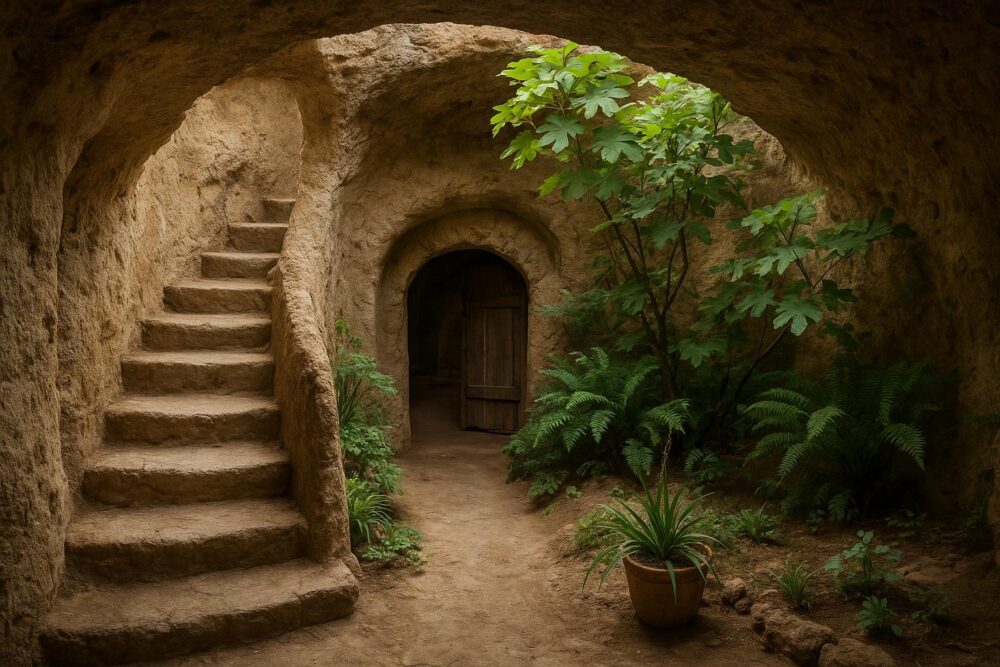
You can walk down into a hand-carved courtyard in Fresno and still feel the decisions of the man who dug every tunnel and planted every vine. The place looks impossible until you learn it was the work of one person, piece by piece. That fact is the heart of the Forestiere Underground Gardens story.
## Forestiere Underground Gardens History: Origins And Impact
Baldassare Forestiere arrived in California from Sicily in the early 20th century with a few dollars and a head full of practical knowledge. He bought land in Fresno and, to protect trees from the valley heat and seasonal chills, began tunneling. The project started small and then, over decades, turned into the sprawling subterranean landscape people visit today. The forestiere underground gardens history is not a tidy set of dates; it’s a biography told in rooms, skylights, and fruit trees.
Forestiere didn’t draw plans. He dug where problems showed up. A patch of soil that wouldn’t hold moisture became a cistern. A bare spot above turned into a skylit courtyard. He relied on observation and repetition—digging, hauling, packing, planting—until the site’s microclimates behaved differently than the flat ground above. That process is the clearest lesson from the forestiere underground gardens history: adaptation beats grand design when you work with local conditions.
### Who Baldassare Forestiere Was
He’s often introduced as an immigrant gardener, but that’s too small a label. Forestiere was part mason, part orchardist, part experimenter. He knew how stones fit together and how roots reacted to sun and shade. He also had to solve problems people in Fresno faced: summer heat that fries fruit, winter frosts, and soil that could be stubborn. His solution was almost stubborn, too—digging and shaping tunnels and rooms until his ideas became architecture.
By reputation he worked alone for years, using picks, shovels, and wheelbarrows. He connected the underground spaces with shafts for light and air, then filled the planters with citrus, grapes, figs, almonds and other Mediterranean-type trees that suit Fresno’s climate. The result reads less like a garden and more like an underground neighborhood.
### How The Gardens Were Built
There’s no single technique labeled “Forestiere method.” He used what was at hand: rock removed from wells and cellars, leftover bricks, gravel, and local soil. He hollowed out vaults and then smoothed and packed the walls to support overlying earth. Skylights and grated openings were arranged to let light reach the planters. The placement of trees took advantage of those shafts so leaves and fruit could still get enough sun.
The design kept temperatures steady. Underground rooms stay cooler in summer and warmer in winter than surface spaces. That thermal buffering meant citrus could be grown with less water stress and fewer frost losses. He also built shallow channels and basins for irrigation; water management was part of the engineering, not an afterthought.
#### Plants And Microclimates
Walk a tour and you’ll notice different sensations from one room to the next. Some pockets feel humid and sheltered, perfect for figs and pomegranates. Others get more reflected light and support grape arbors that run across vaulted ceilings. He mixed ornamentals with food-bearing trees, so the functional and the beautiful were never separate.
Today, the mix still works. The underground gardens in Fresno show how plant selection and placement create reliable yields even under a variable climate. The site is a practical lesson for anyone thinking about microclimates and small-scale resilience.
### The Site’s Place In Local History
Fresno’s identity is tied to agriculture, and the underground gardens became an odd but beloved local landmark. The moment when the property shifted from private experiment to public curiosity matters: neighbors started visiting, word spread, and the site became part of Fresno’s tourism map. It’s neither a blockbuster theme park nor an untouched ruin; it sits somewhere in the middle, a place where ordinary ingenuity earned a lasting presence.
Local historians point to the gardens as a vivid immigrant story—someone bringing skills from abroad and reworking them to fit a new landscape. That angle keeps the forestiere underground gardens history alive in school talks, neighborhood walks, and civic preservation efforts.
### Tours, Preservation, And Challenges
The gardens are open to visitors on guided tours. Guides explain construction choices, highlight notable trees, and tell stories about Forestiere himself. Preservation is ongoing work; masonry needs attention, drainage must be maintained, and the living collection evolves as trees age and are replaced. Climate change and shifting water rules add another layer of challenge. Keeping an underground, water-dependent garden healthy in the San Joaquin Valley is a hands-on job.
Community groups and private stewards have stepped in over the years. They balance allowing people through the fragile spaces with the need to protect fragile walls and roots. That tension is part of the living history—how you maintain something that was always meant to be both machine and garden.
### Why The Forestiere Underground Gardens History Still Matters
The gardens are a reminder that low-tech solutions can stretch decades. Forestiere’s approach—observe, test, adapt—feels modern in its own modest way. People who study sustainable landscaping or passive cooling still look at the place and nod; it’s a case study in microclimate control and site-specific design. And there’s a social lesson too: one person, rooted in a neighborhood, can change the way people see a piece of land.
If you study the forestiere underground gardens history, you don’t just get facts. You see the flaws and triumphs of a life-long project: a few failed tunnels, trees that didn’t thrive, and rooms that turned into useful niches. The whole thing is part improvisation and part stubborn craft. It’s messy and deliberate at once.
The underground gardens fresno site keeps drawing attention because it resists tidy categorization. It’s a garden and a construction project. It’s an artifact and a living place. For visitors and locals alike, that contradiction is the point.
### Visiting And Learning From The Site
Arrive expecting stories and physical proof of long-term work. Tours show techniques and point out clever details: how a skylight is angled, where a planter sits to catch reflected heat, where a passage doubles as an air shaft. If you’re thinking about your own yard, you can leave with small, practical ideas—plant selection, shade strategies, or water capture—that are simple to try.
There are plenty of photos online, but nothing replaces walking the passages and feeling the temperature drop. The human scale matters. The labor is visible in tool marks and patched walls. That’s why the forestiere underground gardens history is compelling: it’s tangible, not just a story in a book.
A final, mundane note: if you’re writing about the gardens, check current tour times and preservation status before you go. Details change. And expect to see one little misspelled sign somewhere—human projects leave that sort of trace, too.