## Sanger California History In Context
You don’t have to dig far to see how sanger california history shaped a wide swath of Fresno County. The town sits where rail lines met irrigated fields, and that intersection set the pattern: a compact Main Street, warehouses for packing fruit, and neighborhoods that grew as seasonal work became year-round life. Sanger’s story is small-scale but stubbornly detailed — local schools, veterans’ halls, and churches that kept records and memories when the rest of the world moved on.
### Early Settlement And The Railroad Axis
Railroads put lots of Central Valley towns on the map, and Sanger was no exception. Tracks brought people, supplies, and the ability to ship perishable crops quickly. Settlers followed the promise of water. Canals and ditches extended from the Kings River and allowed orchards and vineyards to replace brush and wild grass. That shift from rangeland to orchard is a recurring theme in sanger history and across nearby communities.
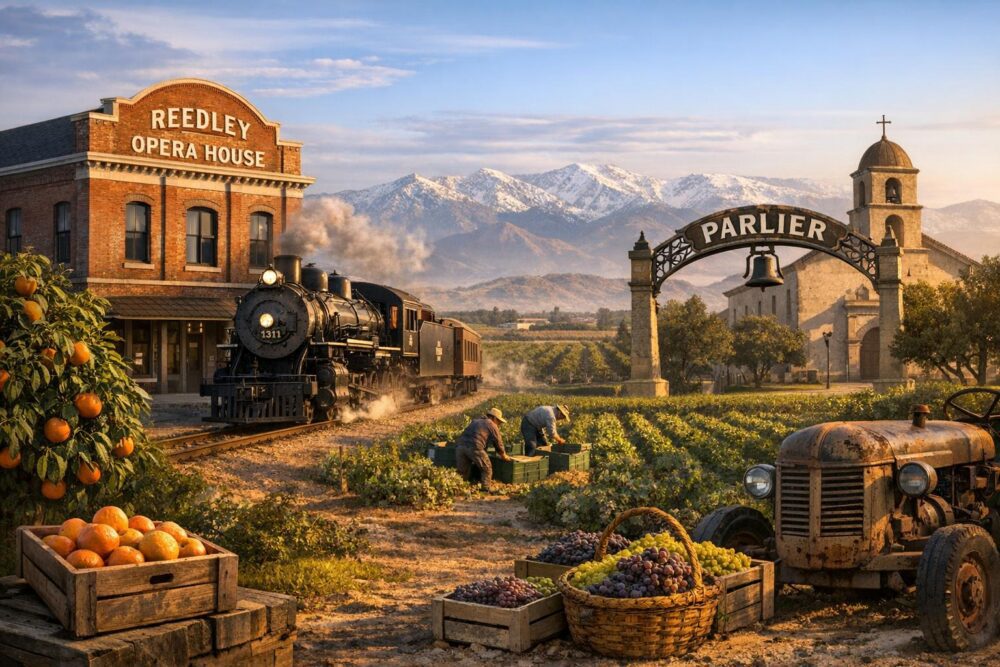
Reedley and Parlier sprung up in the same pattern. Reedley started as a farming hub with a straight, tree-lined avenue and packing houses clustered behind the downtown. Parlier grew from a handful of growers into a center for table grapes and raisins. Each town developed its own rhythms — harvest seasons that defined the year, school calendars that bent around picking, and local economies that depended on good water years.
#### Reedley: Orchard Town And Community Roots
Reedley’s streets still show the imprint of early orchardists. Where you see houses shaded by mature fruit trees, you’re looking at the work of multiple generations. Local businesses grew up to serve those growers: blacksmiths turned to machinery repair, feed stores became implement dealers, and small banks financed land purchases.
The community here built institutions quickly. Reedley High School’s football field, the local rotary, and church basements were places where seasonal workers, growers, and merchants met. Reedley’s civic focus remained tied to the land. When a freeze threatened apricots or a water canal needed repair, the town mobilized in ways that reveal the practical side of sanger history — neighbors doing the heavy lifting to keep harvests on schedule.
#### Parlier: Fields, Labor And Identity
Parlier’s profile comes from grapes and labor — long rows of vines and a workforce that arrived seasonally and eventually put down roots. Parlier’s identity is wrapped up in harvest cycles: pruning in winter, bloom in spring, and the intense work of harvest in late summer and fall. That tempo shows up in local institutions and festivities.
The parlier history of organized labor and mutual aid matters here. Growers, crew leaders, and laborers developed networks to manage housing, transportation, and food supplies. Over time, workers who began as migrants became homeowners, business owners, and part of the civic fabric. You can still trace that lineage in small markets, family-run restaurants, and local clinics that once started as makeshift services for field workers.
### Water, Irrigation, And The Agricultural Economy
Water explains a lot of the Central Valley’s layout. Canals, levees, and later, wells, allowed cultivation of new crops. Once orchards and vineyards were established, their value encouraged more investment: better packing lines, cold storage, and improved road links. The Central Valley’s ability to supply eastern markets depended on those networks, and towns like Sanger, Reedley, and Parlier were nodes in that network.
Sanger’s farms rotated crops in response to market and climate pressures. When table grape prices soared, growers planted more vines. When citrus found a premium, groves expanded. That pragmatism is a throughline in sanger california history: landowners and farmers learning fast, switching crops, and taking risks when a new variety or export market opened.
Irrigation projects also reshaped labor patterns. Mechanized harvests reduced some longtime jobs but created new ones in packing and transport. Bracero-era labor and migration from other parts of the U.S. altered local demography. Those shifts show up today in family names on storefronts and in the bilingual signs in school classrooms.
### Architecture, Schools, And Civic Life
Walk Sanger’s downtown or Reedley’s main drag and you’ll notice a particular kind of civic pride. Brick facades, modest post offices, and libraries that started as Carnegie grants — they’re markers that communities invested in permanence. Those buildings tell a quieter side of sanger history: local governments trying to create stability amid boom-and-bust harvest cycles.
Public schools mattered more than people often credit. High school sports, band programs, and vocational classes were ways communities held together during hard years. When fields were thin, fundraisers and bake sales kept presses running and buses on the road. Family stories often begin with a forebear who taught for twenty years or coached football despite little pay — the kind of detail that gets left out of big histories but matters in famliy albums and town memories.
#### Festivals, Markets, And Cultural Traditions
Harvest festivals and farmers markets serve as both economic and social glue. Reedley’s growers used to gather for annual shipping meetings; Parlier celebrated the grape season with small fairs; Sanger ran parades around holidays tied to agricultural cycles. Those events were more than nostalgia — they were practical moments for growers to share techniques, for workers to find seasonal placements, and for small businesses to market goods.
Food culture grew out of that mix. Family-run bakeries selling pastries influenced by immigrants, meat markets that learned to cut for large crews, and taco stands that opened early for crews heading into the fields — all of this reflects threads of parlier history and sanger history woven into everyday life. The local fairgrounds still host 4-H events and livestock auctions that carry both tradition and commerce.
### Migration, Demography, And Social Change
Two demographic currents shaped these towns: the inflow of migrant workers and the gradual transition of many into settled residents. In practice, this meant new housing patterns and shifting school populations. Language use in classrooms changed; bilingual programs grew. Churches and social clubs adapted to serve a more diverse public.
The migration story also includes return migration. Farmers or workers who saved money elsewhere came back to buy parcels, start businesses, or invest in community infrastructure. That cyclical movement is a constant in sanger california history — people leaving and returning with experience, capital, and different expectations for local life.
Labor politics and organizing played out in local forms. Negotiations over wages, living conditions, and transportation happened quietly in union halls and more publicly in picket lines. These debates affected not only paychecks but also how communities thought about fairness and inclusion.
### Economic Shifts And Environmental Constraints
Markets shifted. Global competition changed what crops made sense. Mechanization replaced some kinds of labor. At the same time, climate variability and groundwater levels changed the calculus for irrigation. Town leaders had to balance immediate needs — keeping packing houses busy, roads maintained — with long-term sustainability.
Sanger and its neighbors saw new investments in cold storage and refrigerated transport, which kept fruit fresh longer and opened farther markets. But those gains came with costs: consolidation of small growers into larger holdings, pressure on housing stocks for seasonal workers, and debates over water rights that could get political fast.
### Memory, Museums, And Local Storytelling
Local historical societies and small museums became custodians of these stories. They keep ledgers, photos, and oral histories that might otherwise vanish. A photo of a packing line from the 1940s tells both the technology of the period and the daily rhythms of hundreds of workers. A ledger with names and shipments maps migration and economic ties.
These places don’t polish every rough edge. They keep evidence of disputes — labor strikes, property battles, and environmental fights — because those conflicts shaped what the towns became. If you want to understand sanger california history beyond postcards, those archives are where you go.
### How Reedley, Parlier, And Sanger Talk To Each Other
The towns share services and schools, overlapping hospital districts, and interlocking economies. Truck routes run through all three; harvest calendars coordinate so packing houses don’t jam. That practical cooperation is the region’s quiet success. It’s not always smooth, but it keeps fruit moving and families fed.
You see the overlap in cultural events too. Someone from Reedley might shop in Sanger, a Parlier mechanic might work in Reedley, and farmers from all three towns will convene at the same agricultural meeting. Those connections are small, concrete bridges in the ongoing story of sanger history and parlier history.
### Still Unfolding
These towns are still negotiating what growth looks like. New housing developments press against orchards. Younger residents look for jobs that don’t depend on picking seasons. Climate pressures make water a central question. In that sense, sanger california history is not a closed book — it’s a set of practices and choices that locals reread and revise every harvest season, every school year, every municipal election.