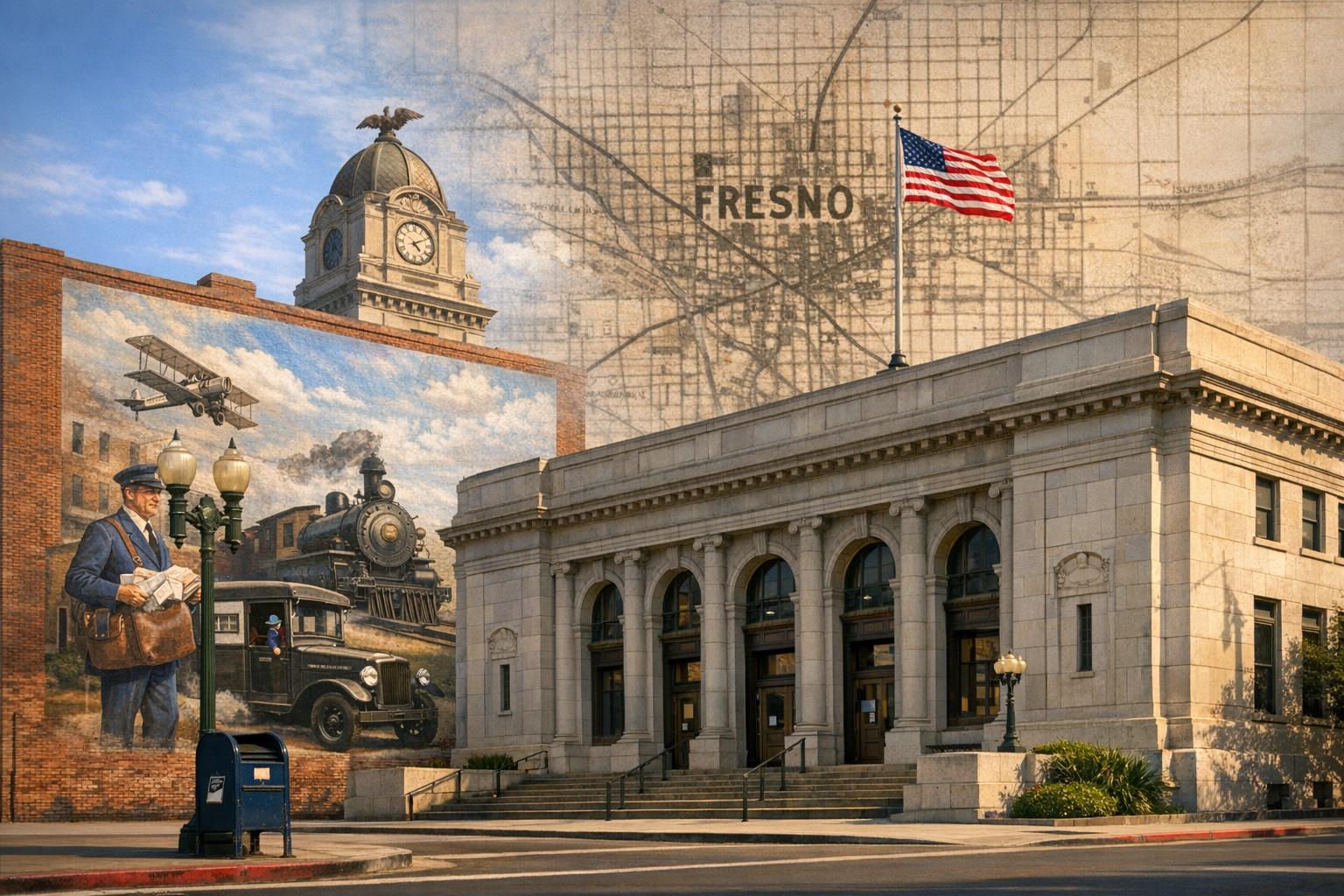
The downtown streets of Fresno read like an open letter: broad strokes of color on brick, bronze plaques sunk into sidewalks, and faded facades that once hummed with the arrival and departure of letters. Those visual elements form a living archive—murals that dramatize civic life, and maps that chart the routes, both literal and cultural, of communication. To walk this city with eyes tuned to postal traces is to connect murals and maps into a narrative about how people and place kept in touch across decades.
## Historic Downtown Fresno Postal History In Paint And Paper
Historic downtown Fresno postal history is stitched into the very fabric of the urban core. Muralists have long used postmarks, stamps, mailbags, and postal clerks as motifs to signal the importance of exchange. At the same time, cartographers and city planners left paper traces: Sanborn fire maps, postal route maps, and postal service directories that reveal where post offices once sat, where routes turned to dirt roads, and how the city’s address logic evolved as neighborhoods grew.
These two forms—painted public art and archival maps—offer complementary ways to understand the past. Murals translate the emotional and civic significance of communication into images: a mother reading a letter, a train packed with sacks of mail, or a postman silhouetted against a golden skyline. Maps provide the scaffolding: exact locations, dates of operation, and the shifting topology of delivery zones. Together they create a layered account of how downtown Fresno functioned as a hub in regional networks.
### How Murals Tell Postal Stories
Murals distill complex histories into accessible scenes. In downtown Fresno, artists have referenced postal culture to evoke migration histories, agricultural commerce, and the rhythms of immigrant neighborhoods. A single mural can compress decades—showing a postal horse-and-buggy next to a modern mail truck—so viewers grasp a sense of continuity and change. Moreover, the selection of iconography—envelopes, stamps, the U.S. Postal eagle—signals authority and trust, themes deeply tied to how communities relied on postal services.
### Reading Maps As Social Maps
Maps are not neutral; they encode decisions about resource distribution and civic priorities. Historic postal route maps show where delivery was prioritized and where gaps remained. For example, early rural routes prioritized farms that fed markets in Fresno, while urban route maps reveal dense clusters of addresses that supported downtown commerce. Overlaying mural locations on these maps can highlight disparities and the specific communities whose stories were celebrated or omitted.
## Murals As Community Memory And Activism
Murals are public declarations. When a neighborhood commissions a mural featuring postal motifs, it is often asserting a claim to presence and history. In downtown Fresno, several pieces celebrate the labor of postal workers and the mail’s role in connecting migrant farmworker families to distant kin. These scenes are not mere nostalgia; they are active remembrances that reinforce how communication sustained social networks.
### The Artists Behind The Scenes
Local and visiting artists approach postal themes with varied intentions. Some create literal depictions—a clerk stamping a letter—while others layer symbolism: stamps as windows into global diasporas, postmarks as time capsules. Funding sources matter, too: city-sponsored programs often emphasize civic unity, while grassroots projects can foreground marginalized narratives. The intersection of aesthetic vision and community priorities determines whose histories are painted large on downtown walls.
### Preservation Challenges For Outdoor Art
Murals age under sun, pollution, and graffiti. Preserving them requires coordination between property owners, the city, and conservators. The conservation choices made around postal-themed murals affect how long future generations can read those public documents. A remedial approach that balances aesthetic integrity with practical protection is essential to keep those visual histories legible.
## 1. A Practical Remedy For Preserving Postal Murals
When a postal mural in downtown Fresno shows flaking paint, surface grime, or fading pigments, a careful conservation approach will stabilize and protect it. The remedy below is intended for use by trained conservators or under their supervision; improper treatment can worsen damage. This section is formal and procedural to ensure clarity and safety.
#### Required Materials
– Soft natural-bristle brushes (various sizes)
– Low-pressure water sprayer or distilled water and clean buckets
– pH-neutral, nonionic conservation detergent (e.g., a recognized formulation)
– Cotton swabs and lint-free cotton cloths
– Conservation-grade acrylic consolidant (for paint lift)
– UV-stable, breathable varnish or sacrificial coating formulated for murals
– Personal protective equipment: nitrile gloves, safety goggles, masks
– Scaffolding or stable access equipment
– Documentation tools: high-resolution camera, notes, color charts
#### Step-By-Step Conservation Procedure
1. Assessment and Documentation:
– Photograph the mural in high resolution under consistent lighting.
– Record dimensions, materials used, condition issues (flaking, mold, graffiti).
– Compare with any existing artist documentation or sketches.
2. Surface Dry Cleaning:
– Using soft brushes, remove loose dust and particulate matter from the surface, working from top to bottom.
– Avoid abrasive action near flaking paint areas.
3. Testing Cleaning Methods:
– In an inconspicuous area, test distilled water applied with a cotton swab, then the pH-neutral detergent diluted per manufacturer instructions.
– Observe for color bleeding, pigment solubility, or paint lift. If pigments are water-sensitive, proceed with extreme caution and consult a conservator.
4. Gentle Wet Cleaning:
– Apply cleaning solution sparingly with cotton swabs or low-pressure sprayer, working small sections at a time.
– Rinse immediately with distilled water to remove detergent residues.
– Blot gently with lint-free cloth—do not rub.
5. Consolidation of Flaking Paint:
– For areas where paint is lifting, apply a conservation-grade acrylic consolidant using a fine brush or syringe. Work under magnification where possible.
– Allow curing per product instructions and monitor for any changes.
6. Protective Coating Application:
– Once stabilized, apply a UV-stable, breathable varnish recommended for outdoor murals. Use thin, even coats and allow full drying between applications.
– Consider a sacrificial coating specifically designed for anti-graffiti protection if the mural is in a high-risk area.
7. Ongoing Maintenance Plan:
– Schedule periodic inspections (every 6–12 months).
– Document any changes and perform light cleanings as needed.
– Engage community stakeholders in stewardship to reduce vandalism and promote upkeep.
8. Conservation Records:
– Keep detailed records of all treatments, including materials and lot numbers, for future conservators’ reference.
## Cartographic Trails: Maps That Guide Rediscovery
Historic maps are the counterpart to murals. Sanborn maps, city planning plates, and old postal route diagrams help researchers pinpoint long-gone post offices, sorting facilities, and distribution hubs. When layered with modern GIS data, these maps illuminate shifts in downtown Fresno’s functional geography and show how postal infrastructure moved in response to railroads, highways, and economic transformations.
### Where To Find Archival Maps And Records
Local repositories—libraries, historical societies, and municipal archives—hold the paper evidences of postal networks. Researchers interested in fresno postal history can consult city directories, postal bulletins, and vintage maps to trace addresses and service changes. Cross-referencing mural locations with archival maps can validate artistic interpretations or uncover overlooked sites worth chronicling.
### Using Maps To Design Walking Tours
Maps make it possible to design interpretive walking tours that link murals to former postal sites. A tour might begin at an old post office building, proceed past a mural depicting mail and migration, and stop at a plaza marked by a cartographic plaque. Such tours encourage residents and visitors to engage with the city’s layered histories and support local heritage tourism.
## Community Engagement And Stewardship Strategies
The best preservation outcomes combine artistic vision with community ownership. Neighborhood associations, businesses, and the postal service itself can collaborate to sponsor mural maintenance, install interpretive map panels, and host public programming. Story-gathering initiatives—collecting oral histories about mail delivery, postmasters, and letters that mattered—can be displayed alongside murals and maps, adding human voices to visual narratives.
### Educational Opportunities
School programs and university partnerships can use murals and maps as pedagogical tools. Students can learn about cartography, local labor history, and the practicalities of postal logistics. Workshops can teach basic conservation awareness—how to avoid touching fragile paint and how to document changes—so everyday citizens contribute to long-term stewardship.
### Funding And Policy Considerations
Securing funding for mural preservation and mapping projects often requires a mix of public grants, private sponsorships, and community fundraising. Policies that protect historic façades and incentivize maintenance—like tax credits or mural conservation grants—help make preservation feasible. Advocating for such measures ensures that downtown Fresno’s postal markers remain an accessible part of urban memory.
The interplay of murals and maps creates a rich mode of historic inquiry. Each painted letter and cartographic line invites closer study, revealing the civic rituals of sending and receiving, the labor of those who moved messages, and the communities that depended on postal networks. Exploring historic downtown fresno postal history through these twin lenses reawakens places that might otherwise be read only as storefronts or transit corridors, and it gives residents tools to preserve both art and archive for future readers of the city.